Roman Szmal Aquarius Swatches

Roman Szmal is a relatively new brand of watercolors from Poland. I read many glowing reviews, so of course I had to try them myself. I can confirm: the hype is well-deserved.

Here are some reasons to add this brand to your collection:

  • The paints are made with a gum arabic and linden honey binder, which makes them smooth and creamy to work with.
  • They are some of the cleanest, most vibrant watercolors I’ve ever worked with.
  • Most paints in the collection are single-pigment, so there are endless mixing possibilities.
  • They offer pigments that are unique to their brand, such as PY168 (Aquarius Yellow), PBk32 (Perelyne Green Deep).
  • In addition to the unique pigments, they use other hard-to-find pigments that are only available from one or two different brands, such as Azo Red (PR144).
  • Each batch is made by hand and tested for quality and consistency.
  • The paints are very affordable, with most full pans costing around $5.

Below are sample swatches of a selection of colors I bought. I could fill up another page with the others! I chose these because they were the ones I was most excited to try.

They are available at Jackson’s Art Supplies in sets and open stock full pans. Unfortunately, the do not come in tubes.

* In February 2022, they added 12 new colors to their already impressive range of products. I will post swatches after I complete them but, I must say, the ones I’ve tried are exquisite! *
Caran d’Ache Gouache Review

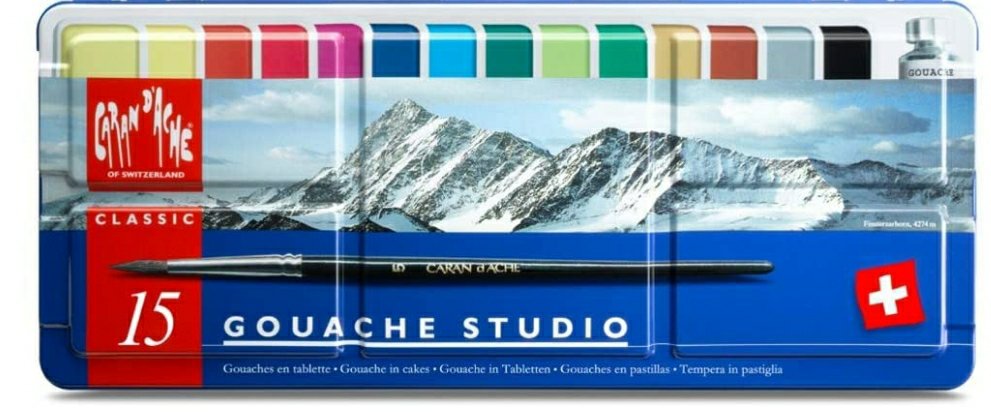
I’ve never owned a set of gouache but, based on a glowing recommendation, I decided to purchase a 15-color set of Caran d’Ache Classic Gouache. As soon as I opened the package, it was love at first sight. The presentation is beautiful.

The set comes with 14 colors of gouache and a tube of white. They include a size 8 synthetic brush which I liked very much. There are also 5 large wells on the lid for mixing.

The only qualm I have with the presentation was the absence of color names on the pans. It required a bit of research to identify the colors. The pans include the product numbers on the side in very small print, so I had to find the official chart with corresponding color names.

Caran d’Ache Gouache color chart.

Before I did swatches, I labeled my pans with the information I found for easy identification when I am painting.

My swatches.

I found the pigment information on Wet Canvas which will be helpful when mixing colors. Note that they call product number 090 “Magenta” while the official name is “Purple.”

The Verdict: This is a very useful, versatile set of paints. It contains warm primaries consisting of Yellow (010), Vermilion (060), and Ultramarine (140). There are also cool primaries: Lemon Yellow (240), Purple (090), and Carmine (080). These colors alone will give you a wide range of hues. I anticipate the other colors in the set will produce lovely mixes as well.

Caran d’Ache does it again. I was never very interested in gouache, but I certainly am now.

Handmade Bookmark with Colored Pencil Swatches

I explained how I made these bookmarks in my previous post. As a testament of how easy they are to make with the right tools, I made another one in the same night!

I used colored pencil swatches for this one. The top swatch is Faber-Castell Polychromos; the middle swatch is Prismacolor Premier Soft Core; and the bottom swatch is Caran d’Ache Luminance .

Handmade Swatch Bookmark

I recently made some Caran d’Ache Neocolor II swatches and wrote about them in a previous post. I used Color Combo stamps from Waffle Flower to print the layouts and spent about 2 hours coloring them in.

If you aren’t familiar with Neocolor II, they are highly-pigmented water-soluble crayons. You can use them dry or activate them with water.

Finished Neocolor II swatches.

I love making things with my manual die cutter and I have a steel rule die from Waffle Flower (obviously one of my favorite suppliers) that I use to make tags. I decided to use some of these swatches to create a bookmark.

First, I cut out the swatches I wanted to use. Then I glued them to the tag. As a finishing touch, I added a tassel.

I was so pleased with it that I decided to start on another one! It was an easy project when using the right tools.

Prismacolor Premier colored pencil swatch on Canson XL paper.

I’m going to use Caran d’Ache Luminance and Faber-Castell Polychromos to do the other two swatches.

Stay tuned for my second bookmark!

The Search for the Best Colored Pencil Paper: Part 4 – Stonehenge Hot Press

It’s no secret that Stonehenge is one of my favorite brands of paper. There’s good reason for that – they make high-quality, affordable products. There are also many varieties to choose from with each option coming in a variety of sizes.

Since I primarily make tiny art, I always search for the smallest pads I can find. Legion has many of their products available in mini-sizes. This pad of hot press is 2.5″ by 3.75″ which is slightly bigger than Strathmore Artist Trading Cards. These pads are perfect if you work on a small scale.

I want to spend some time with my set of oil-based Faber-Castell Polychromos colored pencils, so this test of Stonehenge Hot Press only pertains to those.

From the very first pass, I knew I was going to love it. It has the perfect amount of texture for the oil-based pencils, which excel on a medium-tooth surface. Even though I didn’t try wax-based pencils on Stonehenge Hot Press yet, I anticipate it to be a good substrate for those as well.

The Verdict: this an excellent choice for Polychromos colored pencils (and Faber-Castell Albrecht Durer Watercolour Pencils, which I will discuss in a separate review).

Closeup of burnished color. I used a wax-based Caran d’Ache blending stick and a felt burnisher.

Search for the Best Colored Pencil Paper: Part 3 – Legion Stonehenge Aqua Cold Press

Full disclosure: I love every single Stonehenge paper product I’ve tried. They are perfection, plain and simple. The Aqua Cold Press is no exception.

Available in pads, blocks, and sheets.
Closeup of texture
Sheet thickness

In Part 1 of my search for the best colored pencil paper, I described the differences between the 4 brands of colored pencil I’m using in my test: Caran d’Ache Luminance, Caran d’Ache Pablo, Faber-Castell Polychromos, and Prismacolor Premier Soft Core. The differences between the properties of pencils affect the way they will perform on the paper, so it’s worth a quick read if you aren’t familiar with the pencils.

Before I did a more methodical test, I just wanted to play a bit with gradients of my two favorite pencils: Luminance (wax-based) and Polychromos (oil-based). They both preformed exceptionally well, however Luminance applied more smoothly. It’s worth noting that the scraps I used were trimmed from the edges of a watercolor I was working on and, despite being banged up, they still easily accepted thick layers of color.

Left: Caran d’Ache Luminance; Right: Polychromos

Then I moved on to test all four of the brands I mentioned above. From left to right, the colors I used are as follows:

  1. Polychromos – Rose Madder Lake
  2. Polychromos – Skyblue
  3. Prismacolor – Lilac
  4. Luminance – Spring Green
  5. Pablo – Orange *
  6. Luminance –Anthraquinoid Pink
  7. Luminance – Light Malachite Green
  8. Pablo – Lemon Yellow
  9. Prismacolor – Non-Photo Blue
  10. Polychromos – Dark Cadmium Yellow
*I snagged the paper with a sharp pencil point on the 5th square. Despite it looking like a total mess right after it happened, I was able to use some Gamsol mineral spirits to smooth out the color.

The Verdict

Stonehenge Aqua Cold Press is an excellent choice for both oil and wax based colored pencils. I slightly preferred the wax-based pencils to the oil-based pencils, because they allowed a couple more layers of coverage. The application is velvety-smooth even after several layers of color have been added. There was virtually no wax bloom to speak of. This paper is at the top of my list for both watercolor AND colored pencil projects.


Here is a 🟢 BONUS DOT 🟢 showing 1) light, 2) medium, 3) heavy, and 4) burnished Polychromos application.

Tiny, Dotty Art for the Scrapbook of Scraps

I set aside some time today to re-purpose colorful watercolor scraps to make some tiny art.

Awhile back, I made this dotty watercolor test out of some new Winsor and Newton Professional Watercolors I bought. I can’t remember what colors I mixed to make the background. I had it left over from a different project. The other colors are all Winsor & Newton straight from the tube and the list is as follows:

  • Manganese Blue Hue – PB15
  • Rose Dore – PV19, PY97
  • Indian Yellow – PO62, PY139

I used my beloved Arches Rough Watercolor Paper, which I wrote about in detail in a previous post (click here).

These are the steps I took to re-purpose this tiny scrap that was too colorful for the wastebasket…

Polkadotting the frame

My Spellbinder Platinum manual die cutting machine gets a daily workout. If you make tiny art, this is an invaluable tool to make mounts and frames. To make this frame, I used steel rule nesting dies to cut the ideal size frame for my picture. I used Astrobrights 65 lb/176 gsm bright white cardstock.

I decided that I wanted to make it extra dotty, so I used a Faber-Castell small-nib (0.3mm) Pitt Artist Pen to make tiny dots on the frame. The cardstock holds up well – there was no bleeding on the other side.

Closeup of the pre-glued frame

After I finished dotting the cardstock, I used Tombow MONO Multi-Liquid Glue to adhere the frame to the picture. Now that it’s dry, I get to find a home for it in my scrapbook!

Finished product

Search for the Best Colored Pencil Paper: Part 2 – Arches Rough Watercolor Paper

After trying typical drawing paper for colored pencils (Bistol smooth/vellum, Strathmore colored pencil paper, etc.) and being unhappy with the results, I zoomed in on watercolor paper as a better option. The texturized surface and thickness of the cotton allow for more layers of color and fuller coverage.

There are so many brands and types to try, which is another reason I’m excited to use watercolor paper for colored pencil art. However, there were certain kinds I didn’t think would translate well. One of papers that I assumed would preform poorly was Arches Rough Watercolor. Spoiler alert: I loved it.

A block of Arches Rough.

As you can see from the picture below, Arches Rough is heavily texturized. I thought it would be too toothy for colored pencils, but it turned out to be an absolute joy to work with. The toothiness was part of the fun of application.

Here is my test strip, using the following brands of pencils: Carand’Ache Pablo, Caran d’Ache Luminance, Faber-Castell Polychromos, and Prismacolor Premier Soft Core. Refer to Part 1 of this series for a description of the pencils.

Colors (left to right) are:

  1. Pablo – Grass Green
  2. Pablo – Cobalt Blue
  3. Luminance – Orange
  4. Polychromos – Indanthrene Blue
  5. Prismacolor – Dahlia Purple
  6. Prismacolor – Spanish Orange
  7. Polychromos – Cobalt Blue
  8. Polychromos – Light Green
  9. Luminance – Scarlet
  10. Polychromos – Light Yellow Glaze

The verdict: all of the pencils performed well on Arches Rough. The wax-based pencils (Luminance and Prismacolor) worked the best. They applied like butter and resulted in full coverage. I was also able to get full coverage with the oil-based pencils (Polychromos and Pablo), but it took a bit more pressure. The paper allowed for multiple layers of color for each brand of pencil.

I will definitely keep Arches Rough Watercolor Paper on hand for colored pencil art. It isn’t a great everyday paper due to its unique finish, but it will be great for projects where you want to draw focus to highly-texturized objects.

Stay tuned for Part 3 on Stonehenge Aqua Cold Press watercolor paper!

Scrapbook of Scraps Progress Report #1: Manual Die Cutting

Manual die cutting machines and nesting dies are a great investment if you enjoy papercrafting projects. My creative world totally changed when I got my Spellbinder Platinum machine and saw how perfectly uniform I could make swatch cards, easily cut different shapes of paper, and, relevant to my scrapbook project, make tiny frames for tiny pictures.

Let’s start with the dies…

Waffle Flower brand steel rule dies.

You will hear me talk about Waffle Flower a lot. They are a US company that works with designers to create unique stamps, dies, and other papercrafting products that you truly can’t find anywhere else. Today, I spent the afternoon cutting frames for my Scrapbook of Scraps project.

Frame made from Astrobrights cardstock.

After I made several frames, I got out some of my scraps to see what interesting compositions I could make with my sheets upon sheets of color-tester splats.

A bunch of QoR Watercolor splats waiting to be put to good use.

QoR watercolors are super-vivid so this page of tests has lots of potential to chop up into teeny-tiny pictures. I love the way the colors flow on this particular section, but I felt like it needed some Finetec Iridescent Watercolors to make it SPARKLE. Note that I haven’t glued the frame on yet. I was just using it to find my favorite color composition.

After I added some shine and let the paint dry, I cut it the little section out and glued it onto the frame.

Look at the sparkle! It reminds me of an eyeshadow pallette.

Here are two others that I finished today. These are re-purposed Sennelier test strips.

I haven’t glued any of them in my scrapbook yet because I’m not sure where I’m going to place them. Plus, I didn’t want to deal with anymore glue on my hands.

Stay tuned for my progress on the Scrapbook of Scraps!

Quick Color Wheel with Polychromos Pencils

I wanted an excuse to play with my new set of Faber-Castell Polychromos colored pencils so I did a quick color wheel for a ROYGBIV study.

Cheap bullet journal stencil sets have been an invaluable tool for making color swatches. I found a set on Amazon that was perfect for color wheels and this was the result. It took about two hours and I’m happy with the result.