Search for the Best Colored Pencil Paper: Part 2 – Arches Rough Watercolor Paper

After trying typical drawing paper for colored pencils (Bistol smooth/vellum, Strathmore colored pencil paper, etc.) and being unhappy with the results, I zoomed in on watercolor paper as a better option. The texturized surface and thickness of the cotton allow for more layers of color and fuller coverage.

There are so many brands and types to try, which is another reason I’m excited to use watercolor paper for colored pencil art. However, there were certain kinds I didn’t think would translate well. One of papers that I assumed would preform poorly was Arches Rough Watercolor. Spoiler alert: I loved it.

A block of Arches Rough.

As you can see from the picture below, Arches Rough is heavily texturized. I thought it would be too toothy for colored pencils, but it turned out to be an absolute joy to work with. The toothiness was part of the fun of application.

Here is my test strip, using the following brands of pencils: Carand’Ache Pablo, Caran d’Ache Luminance, Faber-Castell Polychromos, and Prismacolor Premier Soft Core. Refer to Part 1 of this series for a description of the pencils.

Colors (left to right) are:

  1. Pablo – Grass Green
  2. Pablo – Cobalt Blue
  3. Luminance – Orange
  4. Polychromos – Indanthrene Blue
  5. Prismacolor – Dahlia Purple
  6. Prismacolor – Spanish Orange
  7. Polychromos – Cobalt Blue
  8. Polychromos – Light Green
  9. Luminance – Scarlet
  10. Polychromos – Light Yellow Glaze

The verdict: all of the pencils performed well on Arches Rough. The wax-based pencils (Luminance and Prismacolor) worked the best. They applied like butter and resulted in full coverage. I was also able to get full coverage with the oil-based pencils (Polychromos and Pablo), but it took a bit more pressure. The paper allowed for multiple layers of color for each brand of pencil.

I will definitely keep Arches Rough Watercolor Paper on hand for colored pencil art. It isn’t a great everyday paper due to its unique finish, but it will be great for projects where you want to draw focus to highly-texturized objects.

Stay tuned for Part 3 on Stonehenge Aqua Cold Press watercolor paper!

The Search for the Best Colored Pencil Paper: Part 1 of a Series – Meet the Pencils

I’m fairly new to colored pencil art and it’s been pretty easy to find review upon review of the best pencils. However, it’s been surprisingly difficult to find reliable information on the best paper to use to make them perform to their full potential.

Since I love experimenting with art supplies, I decided to do my own paper tests. I will be reviewing many types of paper and will share my thoughts here In my reviews, I will be using 4 different brands of artist-quality colored pencils:

  • Caran d’Ache Luminance
  • Caran d’Ache Pablo
  • Prismacolor Premier Soft Core
  • Faber-Castell Polychromos

Due to the composition of the cores (wax-based vs. oil‐based), I knew each product would preform a little differently on each type of paper. It’s important to know what your pencils are made of before choosing your paper. According to my research, the core composition of these 4 products is as follows:

Wax: Prismacolor Premier Soft Core

Oil: Faber-Castell Polychromos, Caran d’Ache Pablo.

Wax & Oil Blend: Caran d’Ache Luminance

The wax-based pencils tend to preform better on toothier, texturized paper while the oil-based pencils preform best on smoother papers. I’m going to try them all and let you know my thoughts. This exercise will be a great learning experience for me and I hope it will help you too.

Stay tuned for reviews. Sneak peek: the first up is Arches Rough Watercolor Paper.

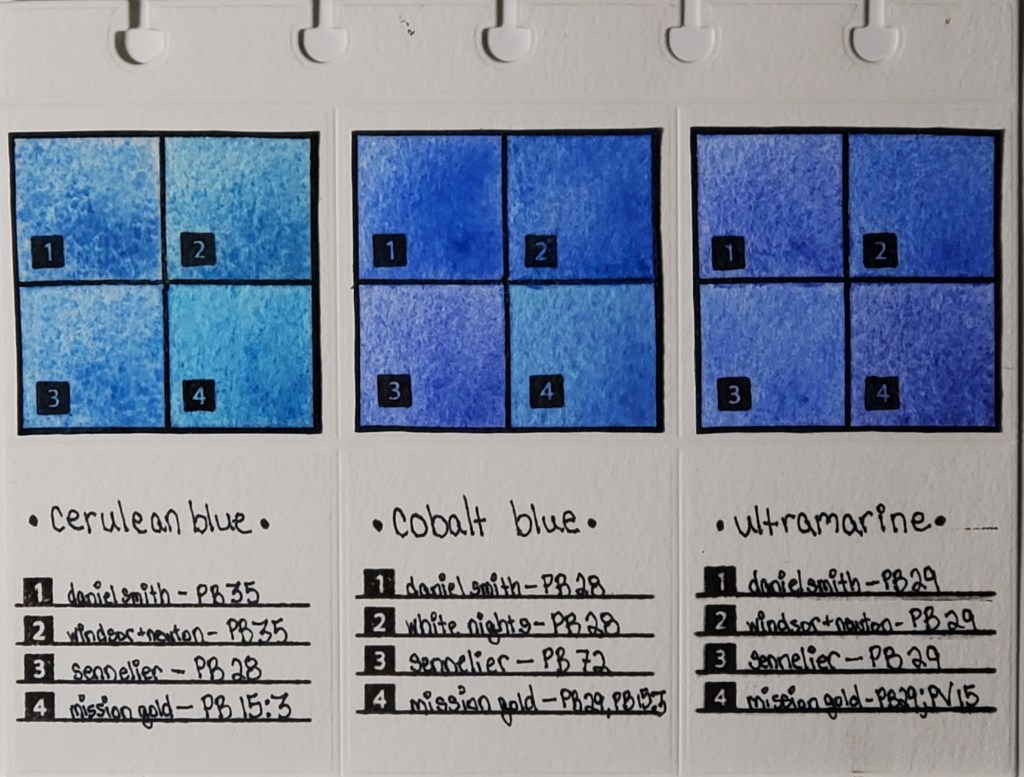
Watercolor Pigment Comparison Swatches: Page 1

Cerulean, Cobalt, and Ultramarine Pigments

Left to right: Cerulean, Cobalt, and Ultramarine Swatches

I’ve been fascinated with how watercolor paints of the same name vary across brands, even when the same pigment is used. For example, you would expect Daniel Smith’s cerulean blue to look nearly identical to Winsor & Newton’s cerulean blue, right? As you can see from the photo, that’s not the case. I decided to do a study of how colors vary between brands. This deceptively simple-looking page actually took months to finish.

Here is the work that went into its creation:

  1. I cataloged all of my watercolor paints into an Excel spreadsheet and noted properties like pigment number, lightfastness, transparency, staining, and granulation.
  2. I used a die cutter to make swatch cards and the pages which I will eventually bind.
  3. I swatched the paints I wanted to compare. Blues are my favorite, so I started with my most frequently-used
  4. I used silicon stamps to assign numbers to the swatches for easy identification.
  5. After I finish my pages, they are going to be bound in a little flipbook which I’m going to keep next to my desk for easy access to the comparisons.

The most important lesson I learned when I began my research is that color names are less important than pigment numbers. Instead of buying colors based on trade names, I look at the pigment listed on the tube to get a better idea of what the color will actually look like.

Stay tuned for new pigment comparisons! I’ve done swatches for Opera Pink, Viridian, and Lemon Yellow that I’m excited to share!


* I know that I misspelled “Winsor” in the pigment descriptions on the finished page. It will haunt me forever.